
Artical
Stop Revenue Leaks in RFQ Intake: Quote to Cash Automation for RevOps

Revenue leaks rarely start in complex enterprise systems—they start right in your inbox. Manual data entry, buried purchase order updates, and fragmented email requests quietly drain time, inflate billing error rates, and stretch out your days sales outstanding (DSO).
Stop Revenue Leaks in RFQ Intake: Quote to Cash Automation for RevOps
Quote-to-cash automation turns quotes into verified, auditable revenue faster and with fewer billing errors, but it only works when you start in the right place. Your first move should be a pilot on inbox-heavy “receive” phases like RFQ intake, order intake, or dispute handling, since that’s where manual work piles up fastest. Done well, this kind of pilot typically shortens days sales outstanding and cuts billing error rates within weeks, not quarters.
TL;DR:
Automating receive-phase processes like RFQ intake, order entry, and dispute handling offers the fastest return on investment due to high volume and manual effort.
Focus on unstructured data, such as PDFs and emails, first, since they carry the highest manual costs and benefit most from document parsing and classification.
Proper automation demands workflow redesign beyond system integration, including exception handling, audit trails, and compliance controls before scaling.
Pilots should target narrow processes with clear success metrics, typically showing measurable improvements within 30 to 90 days, before broader implementation.
Building on an orchestration layer or event-driven architecture enhances reliability and monitoring, especially when connecting multiple complex enterprise systems.
Table of Contents
What Is Quote-to-Cash Automation and How Does the Process Work?
Where Does Automation Deliver the Fastest ROI?
Common Implementation Pitfalls in Quote-to-Cash Automation
How Do You Build a Quote-to-Cash Automation Roadmap?
What Integration Patterns Keep Automation Reliable?
What KPIs and ROI Timelines Should You Expect?
How Newflow Approaches Quote-to-Cash Implementation
What Does Quote-to-Cash Automation Cost to Implement?
Should You Hire a Partner or Build Quote-to-Cash Automation In-House?
How Newflow Turns This Roadmap Into a Working System
Where to Learn More About Quote-to-Cash Automation
Sources
What Is Quote-to-Cash Automation and How Does the Process Work?
Quote-to-cash (Q2C) describes everything that happens between a sales quote and the cash landing in your bank account. It’s broader than configure-price-quote (CPQ), which handles only the front-end pricing and quoting mechanics, and it overlaps with order-to-cash (O2C), a term some teams use interchangeably though O2C technically starts a step later, at order capture. CPQ functions as the front door to the revenue process, feeding into billing, usage tracking, and renewals once a deal closes.
The canonical Q2C lifecycle runs through these stages:
Quote: A sales rep or self-service tool generates pricing based on product configuration and discount rules.
Configure/price: Complex bundles, tiers, or custom terms get calculated and validated.
Contract: Legal and commercial terms are negotiated, redlined, and signed.
Order: The signed deal becomes a formal order record in your systems.
Fulfillment: Product or service delivery happens, whether that’s shipping goods or provisioning a subscription.
Invoice: Billing generates and sends an invoice matching contract terms.
Cash: Payment is collected, matched, and reconciled against the invoice.
Dispute: Discrepancies get flagged, routed, and resolved.
Some of these stages are naturally structured, meaning the data lives in clean database fields your systems already understand. Invoicing and payment reconciliation fall here. Others are unstructured: RFQs that arrive as PDFs, order changes buried in email threads, dispute claims scrawled into a support ticket. That distinction matters more than most implementation plans admit, because it decides which stages you can automate with off-the-shelf logic and which ones need document parsing or classification models before automation even becomes possible.
Where Does Automation Deliver the Fastest ROI?
The receive-side of quote-to-cash is where automation pays off first. RFQ intake, email-based order entry, and dispute classification all involve high volume and heavy manual handling, which makes them ideal automation candidates. Structured stages like invoicing and payment reconciliation are also strong targets, but for a different reason: the data is already clean, so automation there is mostly a matter of connecting systems correctly rather than teaching software to read.
Up to 80% of enterprise data is unstructured, which is exactly why inbox-heavy receive phases tend to be the biggest bottleneck in the entire quote-to-cash chain. Order entry pilots that tackle this problem directly tend to show the clearest early wins because they combine high transaction volume with labor-intensive manual entry.
Prioritize automation work roughly in this order:
Unstructured wins first: Document parsing and email classification for RFQs, purchase orders, and dispute intake, since these carry the highest manual cost per transaction.
Structured wins next: Invoice generation and payment matching, which automate cleanly once the upstream data is trustworthy.
Exception handling last: Build routing logic for disputes and approvals only after you understand your real exception volume from the pilot data.
Common Implementation Pitfalls in Quote-to-Cash Automation
Most Q2C automation projects stall for the same handful of reasons, and nearly all of them trace back to treating “integrate” and “automate” as the same thing. Connecting your CRM to your billing system through an API is integration. Getting a workflow to correctly interpret a customer’s emailed change order, apply the right discount rule, and route it for approval without a human touching it is automation. The second one requires redesigning the workflow itself, not just wiring systems together.
Watch for these failure modes:
Unstructured input errors: Free-text orders or scanned PDFs get misread, and bad data flows downstream before anyone notices.
Missing exception paths: Teams automate the happy path but forget to design routing for the 15% of orders that don’t fit the template.
Revenue recognition gaps: Automated billing that ignores usage-based or milestone-based recognition rules creates compliance headaches later.
Change management resistance: Sales and finance teams route around new tools if the automation doesn’t fit how they actually work.
Pro Tip: Before automating any approval step, map every exception your team handled manually in the last 90 days. If you can’t name your exception categories, you’re not ready to automate the approval flow around them.
How Do You Build a Quote-to-Cash Automation Roadmap?
A workflow audit comes first, always. You’re mapping where time and money actually leak, not guessing based on what looks broken. From there, the roadmap runs in five stages:
Audit and value map: Identify which processes are inbox-heavy, quantify hours spent per week, and flag where errors or delays cost you the most.
Scope a narrow pilot: Pick one receive-phase process (RFQ intake is a common starting point), define 2-3 success metrics, and gather sample documents and data formats you’ll need to test against.
Build the technical foundation: Set up document ingestion, connect API integration points to your CRM or ERP, and configure approval workflows with clear escalation rules.
Establish governance: Build audit trails for every automated decision, set revenue recognition controls, and define exception routing before volume increases.
Scale deliberately: Roll out to adjacent processes on a set cadence, train teams on the new workflow, and monitor performance dashboards weekly during the first quarter.
Roadmap phase | Primary focus | Typical duration |
|---|---|---|
Audit | Process mapping, value quantification | 2-4 weeks |
Pilot | Single process, narrow scope, clear KPIs | 30 days |
Technical build | Ingestion, integrations, approval logic | Runs parallel to pilot |
Governance | Audit trails, recognition controls | Built before scale |
Scale | Rollout, training, monitoring | 3-9 months |
A pilot proves the pattern works before you commit budget to automating everything downstream, which is exactly why a narrow scope matters more than an ambitious one at this stage.
What Integration Patterns Keep Automation Reliable?
The architecture decision that matters most is whether you build on an orchestration layer or integration platform (iPaaS) versus stitching together point-to-point APIs. Point-to-point connections work fine for two systems, but they become fragile and hard to audit once you’re connecting CRM, CPQ, ERP, billing, and payment gateways together. An orchestration layer or event-driven architecture gives you a single place to monitor data flow and catch failures before they become revenue leaks.
Document ingestion is its own decision tree. Basic OCR handles clean, templated documents fine. Machine learning parsing models handle variable formats like handwritten purchase orders or inconsistent vendor invoices. The unstructured layer of emails, PDFs, and remittance notes often needs custom-trained models, which is where off-the-shelf tools tend to fall short and tailored implementation earns its cost.
Beyond ingestion, build in these controls from day one:
Idempotency checks: Prevent duplicate orders or double-billing when a system retries a failed request.
Reconciliation logic: Automatically match payments to invoices and flag mismatches instead of letting them sit.
Full audit trails: Every automated decision needs a timestamped record for compliance and dispute resolution.
Payment data safeguards: Encrypt and segment payment card data separately from general workflow data to limit compliance scope.
Applying order fulfillment automation tactics like automated routing and tracking updates also reduces the manual handoffs that create discrepancies between what shipped and what got invoiced.
What KPIs and ROI Timelines Should You Expect?
Track a small set of metrics that actually reflect revenue health, not vanity dashboards. The core KPIs are quote cycle time, quote-to-order time, days sales outstanding (DSO), billing error rate, dispute resolution time, and the percentage of transactions flowing through automation without manual touch.
KPI | What it measures | Why it matters |
|---|---|---|
Quote cycle time | Time from request to quote delivery | Faster quotes win more deals |
Quote-to-order time | Time from quote acceptance to order creation | Reveals contract and approval bottlenecks |
DSO | Average days to collect payment | Direct cash flow indicator |
Billing error rate | % of invoices requiring correction | Signals data quality upstream |
Dispute resolution time | Days to close a billing dispute | Reflects exception-handling efficiency |
Automation coverage | % of transactions with no manual touch | Measures scale progress |
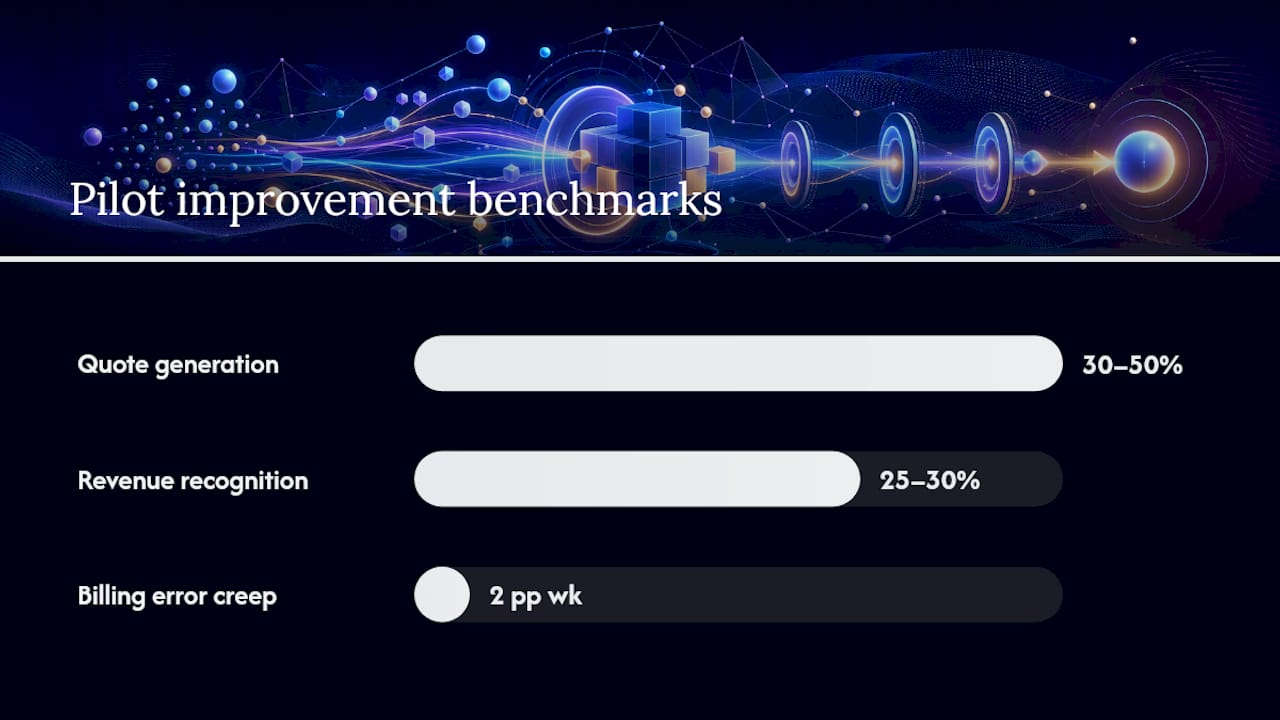
Pilot programs typically show measurable gains within 30 to 90 days, with broader scale rollout taking another 3 to 9 months depending on system complexity. Vendor-reported pilot data commonly cites 30% to 50% faster quote generation and 25% to 30% faster revenue recognition in early deployments, useful as directional benchmarks rather than guarantees for your specific stack.
Build dashboards that alert on threshold breaches, not just weekly summaries. A billing error rate that creeps up 2 points week over week is worth catching before it becomes a quarter’s worth of write-offs.
How Newflow Approaches Quote-to-Cash Implementation
Newflow starts every quote-to-cash engagement with a workflow audit, not a software recommendation. That order matters. Recommending a tool before understanding where your specific bottlenecks live is how companies end up paying for automation that solves the wrong problem.
The approach centers on a few consistent principles:
Audit-first scoping: Every automation plan starts by mapping actual time spent and error patterns across your quote-to-cash chain.
Tailored builds over generic packages: Solutions get designed around your existing CRM, ERP, and billing stack rather than forcing a rebuild.
Cross-industry pattern recognition: Newflow works with startups, e-commerce companies, and SMBs, which surfaces recurring failure patterns worth avoiding.
Ongoing optimization: Automation isn’t a one-time build; workflows get refined as volume and product complexity grow.
(Specific client outcomes and measured results from Q2C engagements will be added here as case studies become available.)
The broader automation philosophy driving this work treats automation as a way to free your team from repetitive admin, not replace the judgment calls that still need a human.
What Does Quote-to-Cash Automation Cost to Implement?
Budgeting for Q2C automation depends heavily on scope, not just company size. A narrow pilot focused on one receive-phase process, like automating RFQ intake, costs far less than a full end-to-end rebuild spanning CRM, CPQ, ERP, and billing integration.
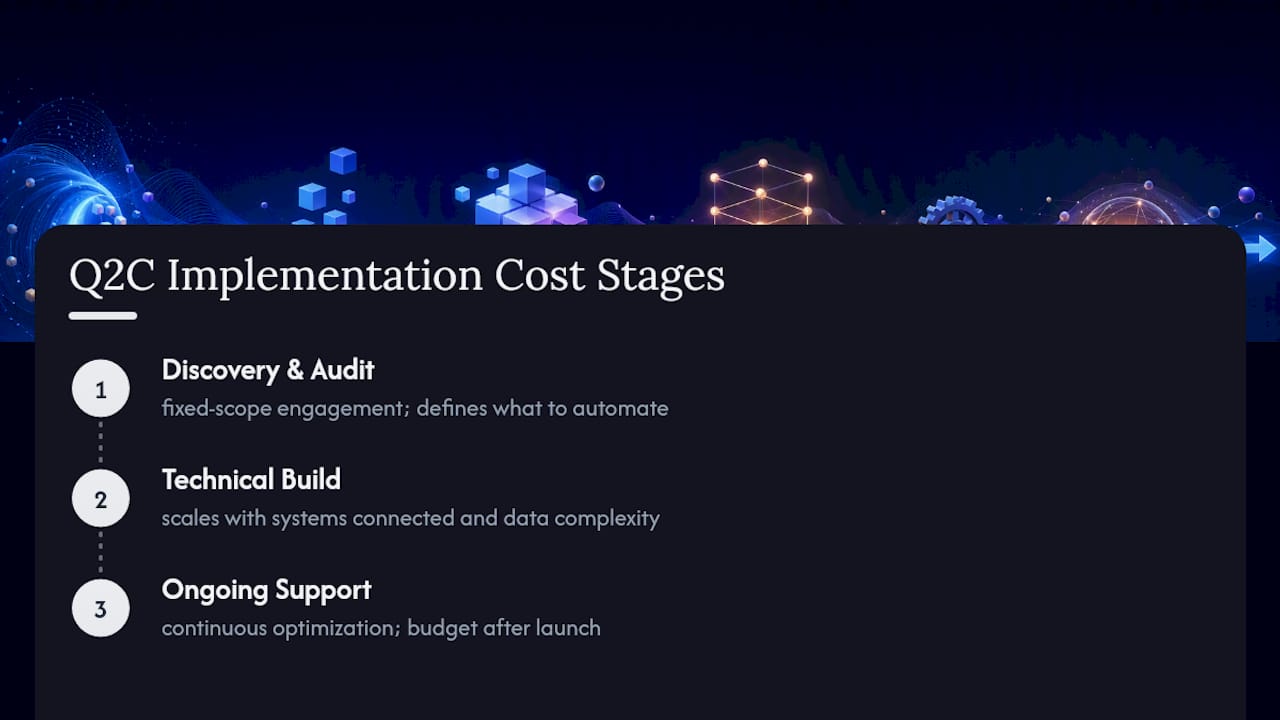
Three cost categories deserve separate line items in your planning. First, discovery and workflow audit work, which typically runs as a fixed-scope engagement and should surface exactly what needs automating before you commit to a build. Second, the technical build itself, covering document ingestion, API integration, and workflow logic, which scales with how many systems you’re connecting and how unstructured your input data is. Third, ongoing support and optimization, since workflows drift as your product catalog, pricing rules, or customer base change.
A common budgeting mistake is treating the pilot and the scale-up as one line item. They aren’t. Pilot costs should be small enough that a failed pilot doesn’t sink your automation budget for the year, while scale costs should only get committed once the pilot proves the pattern works. Factor in integration licensing costs too. Connecting to CRM, ERP, or payment gateway APIs sometimes carries its own subscription or usage fees separate from your implementation partner’s costs.
Plan for ongoing optimization spend after launch, not just the initial build. Revenue recognition rules, discount structures, and approval hierarchies change as your business grows, and automation that isn’t maintained degrades quietly until someone notices billing errors climbing.
Should You Hire a Partner or Build Quote-to-Cash Automation In-House?
The honest answer depends on four factors: company size, pricing complexity, how mature your existing integrations already are, and how fast you need results. If your CRM and ERP barely talk to each other today, a partner accelerates the timeline considerably and reduces the risk of costly rework. If pricing involves multiple tiers, usage-based components, or custom contract terms, in-house teams often underestimate how much workflow redesign that complexity demands.
A partner earns its cost fastest when you need working automation in months, not a year of internal trial and error. Whichever path you choose, insist on real knowledge transfer, documented workflows, and a clear ownership plan so your team can maintain and extend the system long after launch.
— newflow
How Newflow Turns This Roadmap Into a Working System
Newflow builds the exact kind of automation this article describes: workflow audits that identify where RFQ intake, order processing, or dispute handling is bleeding hours and revenue, followed by tailored automation using AI agents, system integrations, and custom dashboards built around your actual stack.
Where to Learn More About Quote-to-Cash Automation
For deeper technical grounding, Tekst’s breakdown of where automation actually works covers the unstructured-data problem in detail. Salesforce’s explanation of CPQ’s role clarifies how quoting connects to broader revenue platforms. For fulfillment-side process detail, Shopify’s order fulfillment guide outlines the operational steps that prevent post-order revenue leakage.
Sources
What Is Quote-to-Cash Automation, and Where Does It Actually Work? — Tekst
10 Order Fulfillment Process Steps for Fast Shipping — Delgate (hosted/summary on Shopify)